Skip to content

Events in Scottish History

April

1st April:  “April Fool’s” day used to be known as “Hunt the Gowk” (a gowk is a cuckoo). Lost in antiquity some suggest origins in 16th century in France, when the new year was changed from 1 April to 1 January, and mocks those slow on the uptake of the change. In France the day’s symbol is a fish.
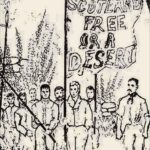
1st April 1820:  Placards which would start the Radical War of 1820, otherwise known as the Scottish Insurrection, were displayed in Glasgow.

2nd April:  “Preen-Tail Day” or “Tailie Day” following All Fool’s Day when paper tails were attached to the backs of unsuspecting people as a joke.

2nd April 1593:  A charter to found The  College of New Aberdeen, later Marischal College was issued by George Keith, the Fifth Earl Marischal of Scotland.

3rd April 1728:  James Anderson, lawyer, historian, genealogist and antiquary, died.

3rd April 1820:  The first day of the Radical War of 1820, otherwise known as the Scottish Insurrection. Work stopped and workers marched on the Carron Iron Works intent on seizing weapons.
radical war 1820
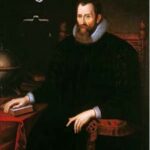
4th April 1617:  John Napier of Merchiston, inventor of logarithms, died.
john napier
4th April 1849:  The Clydesdale Joint Stock Agricultural & Commercial Company was established “for the purpose of acquiring land in some suitable locality in the United States of America, in which to establish by means of the united capital and industry of its partners, a comfortable home for themselves and families, where they may follow a more simple, useful and rational mode of life than is found practicable in the complex and competition state of society, from which they have become anxious to retire.” The members were John Jack, James Love, John Craig, John McAndrews, James Shanks, James Gardner, Robertson Sinclair, John Davis and John Campbell.” See also Alexander Gardner
4th April 1840:  Reverend John Campbell, Missionary, died in South Africa.

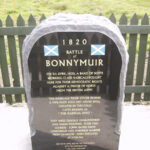
5th April 1820:  The Striking Workers of the Radical War of 1820 on their way to the Carron Iron Works were attacked by Hussars at Bonnymuir.  The leaders were subsequently executed and many others convicted and transported to Australia as criminals.

photo by best dsc!

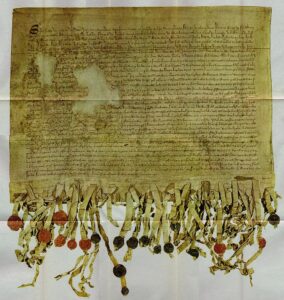
6th April 1320:  The Declaration of Arbroath was drawn up at Arbroath Abbey. It was a letter, in Latin, from the Scottish nobility to Pope John XXII asserting Scotland’s independence and warning of their right to dethrone King Robert I should he “give up what he has begun, and agree to make us or our kingdom subject to the King of England or the English.”
The Declaration of Arbroath is said to have influenced the US Declaration of Independence in 1776.

960px declaration of arbroath
The 'Tyninghame' copy of the Declaration from 1320, in the National Archives of Scotland
6th April 1773:  James Mill, the Scottish philosopher and historian was born. His son was the philosopher, John Stuart Mill.
7th April 1773:  Dr Hugh Blair, born in Edinburgh.
8th April 1783: John Claudius Loudon, landscape gardener and architect, born at Cambuslang, Lanarkshire.
9th April 1747:   Simon Fraser, 11th Lord Lovat, beheaded at Tower Hill for his part in the Jacobite Rising of 1745, at the age of 80.  On the scaffold he encouraged his nervous executioner with the words “Cheer up thy heart man, I am not afraid. Why should you be? ”
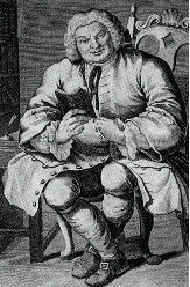
simon fraser lord lovat 1745

10th April 1512: James V born.

james v
10th April 1840:  Alexander Nasmyth, Scots painter, died in Edinburgh.
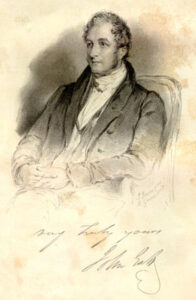
11th April 1839:  John Galt, novelist,   died Greenock, Renfrewshire.
galt image
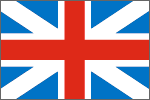
12th April 1606:  The first Union Flag adopted as the Flag of Scotland, England (and Wales) initially a Royal flag and was first known as “the British Flag” or the “Flag of Britain“. (The current version which incorporated Ireland dates from 1801).
uk1606
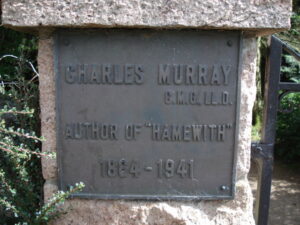
12th April 1941:  Charles Murray, North East poet, died at Banchory, Aberdeenshire.
july august 2007 162
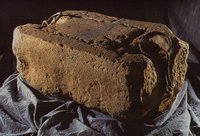
13th April 1951:  The Stone taken from the Coronation chair in 1950 by Scottish Students was returned to Westminster, after having been found at Arbroath Abbey. But is that Stone, now in the Perth Museum, the “Stone of Destiny”
200px stone2
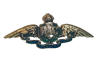
13th April 1912:  King George V signed a Royal Warrant establishing the Royal Flying Corps (RFC) on 13th April 1912. The first Officer Commanding the RFC was General David Y Henderson (born Glasgow 11th August 1862), who took the Corps to France in 1914. 2012 marked the centenary of the founding of the Corps.
800px royal flying corps cap badge small

14th April 1582:  Charter granted by James VI which would lead to the foundation of University of Edinburgh in 1583

590px edinburgh university crest svg
15th April 1641:  Sir Robert Sibbald, physician and geographer, born.

15th April 1710:  William Cullen, physician, chemist and metallurgist, born.

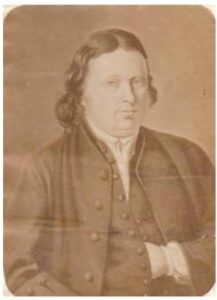
15th April 1714:  Adam Gib, Secessionist minister, born. (Other sources note 7th or 14th April but this is from his memorial at Greyfriars Churchyard)
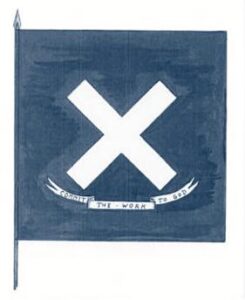
15th April 1746:  The Battle of Littleferry/Bonar Bridge/Skirmish at Golspie near Dunrobin, the Jacobite Earl of Cromartie’s Regiment defeated by Sutherland Militia loyal to the Government.
commit the work to god
15th April 1865:  Poet Walter Wingate born in Dalry, Ayrshire, author of “Sair Finger” and “Paper Kate”.
15th April 1877:  Sir David Ross, philosopher, born in Thurso, Caithness.

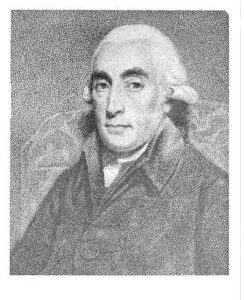
16th April 1728:  Joseph Black MD born.  He was the first to identify CO2, laying the foundation of modern chemistry.

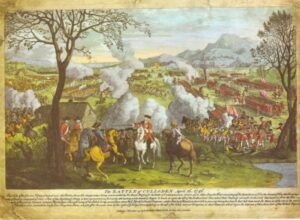
16th April 1746:  Battle of Culloden. Fought on Drummossie Moor near Culloden House, not an English Scottish Battle as often portrayed but the last battle for the Jacobite (exiled House of Stuart) Cause, with Scots on both sides. No Regiment has this as a Battle Honour.

battleofculloden
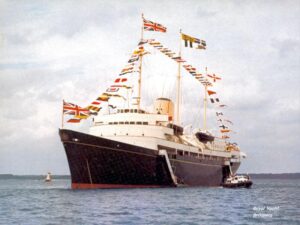
16th April 1953:  HM The Queen launches the Royal Yacht “BRITANNIA” at the John Brown & Co Shipyard, Clydebank.

17th April 1850:  James Thom, the Ayrshire Sculptor, died in New York.
Ref: The Every Day Book Of History And Chronology: Embracing The Anniversaries Of Memorable Persons And Events In Every Period And State Of The World, From The Creation To The Present Time (1858) Munsell, Joel ISBN: 0548583358

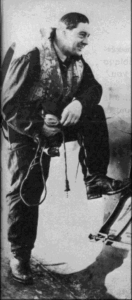
18th April 1916:  Wing Commander Harbourne Mackay Stephen CBE, DSO, DFC, RAF retd, born in Elgin. As a Spitfire Pilot in the Battle of Britain he destroyed 20 enemy aircraft.

19th April 1390:  Robert II, son of  Robert the Bruce’s daughter, Marjorie, died.

robert ii
20th April 1851:  Young Tom Morris, golfer, born, St Andrews.
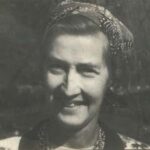
20th April 1918:  Mora Agnes Dickson, author and artist, and later founder with husband Alec of Voluntary Service Overseas, born in Glasgow. Ref: International Who’s Who of Authors and Writers 2004 By Elizabeth Sleeman, ISBN:1857431790
21st April 1671:  John Law, economist, Scottish monetary reformer and originator of the “Mississippi scheme” for the development of French territories in America, baptised.
21st April 1838:  John Muir, America’s most famous and influential naturalist and conservationist, and founder of the Sierra Club, born in Dunbar, East Lothian.
21st April 1926:  The future HM Queen Elizabeth born.
22nd April 1765:  Rev James Grahame, poet and clergyman, born in Glasgow.
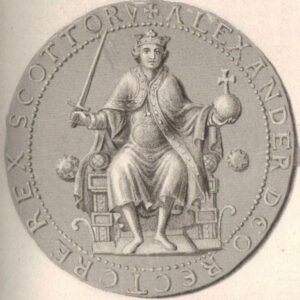
23rd April 1124:  Alexander I died at Stirling Castle.
alexander i
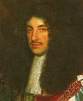
23rd April 1661:  Charles II crowned at Westminster Abbey.
charles ii
23rd April 1781:  General James Abercromby (also Abercombie) commander-in-chief of British Forces in North America in the French and Indian War, died.

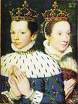
24th April 1558:  Mary Queen of Scots married the French Dauphin, François de Valois, at Notre Dame in Paris.

francoise et marie
24th April 1633:  Privy Council issues a Warrant to Sir David Hepburn to raise a regiment of 1,200 men to fight in French Service. Hepburn’s Regiment later became The Royal Scots, the oldest regiment in the British Army and served for 373 Years before being merged into the new Royal Regiment of Scotland in 2006.
badgereg1
25th April 1058:  Malcolm Canmore  crowned at Scone.
mael coluim iii and mac duib
25th April 1710: James Ferguson, astronomer, fellow of the Royal Society, born.
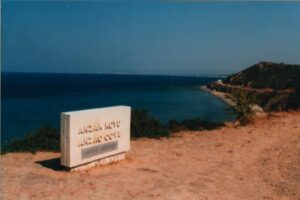
25th April 1915:  ANZAC Day which commemorates the landing of Australian and New Zealand (Australian and New Zealand Army Corps) troops at Ari Burnu on the Gallipoli peninsula in 1915 marking the emergence of the young nations on the world stage and establishing a reputation for courage and determination that stands to this day. The main British Landings were at Cape Helles and Sedd-El-Bahr. The Lancashire Fusiliers famously won “six VCs before breakfast” at W Beach on April 25, and lost 164 men that day.
g1
26th April 1854:  Henry, Lord Cockburn,who campaigned to protect and improve the beauty of Edinburgh  died at his home near the City.
27th April 1650:  The Battle of Carbisdale. The Marquis of Montrose‘s final Campaign, in the North of Scotland, came to an end when his Royalist force was surprised and overwhelmed by Colonel David Strachan.
27th April 1794:  James Bruce, explorer, died at Larbert.

28th April 1842:  Sir Charles Bell, surgeon, anatomist and physiologist died. His most notable achievements were his description of the exterior respiratory nerve (“Bell’s nerve”), his discovery that lesion of the seventh facial nerve causes facial paralysis (“Bell’s palsy”), and his demonstration of the motor function of anterior roots and the sensory function of dorsal roots in spinal nerves (the “Bell-Magendie law”).

29th April 1667:  John Arbuthnot, scholar and Fellow of the Royal Society, born or baptised.

arbuthnot

30th April 1854:  James Montgomery, the Scottish poet and hymn writer died. His hymns included ‘Lift Up Your Heads Ye Gates of Brass’.