The Scottish Division with the Saltire Badge that fought on in France after Dunkirk
“The 51st seems to have been the only BEF formation to display a systematic scheme of ‘battle insignia’ in varying brigade colours. Veterans believe that the St Andrew’s cross divisional sign was worn in purple and green by Div HQ, red by 152nd Bde and brown by 154th, the colour of 153rd is uncertain. Beneath the Saltire battalions with brigades wore differing numbers and arrangements of bars in matching colours; 7 A&SH wore a single brown horizontal bar and 8 A&SH a vertical bar. In 152nd Bde the junior battalion, 4th Cameron Highlanders, wore three thin horizontal bars below the Saltire, all in red.” p 3 The British Army 1939-45 (1) North West Europe published in 2001 by Osprey Publishing
After 1940 the Division re-adopted the better know red “HD” on a blue background shoulder patch.
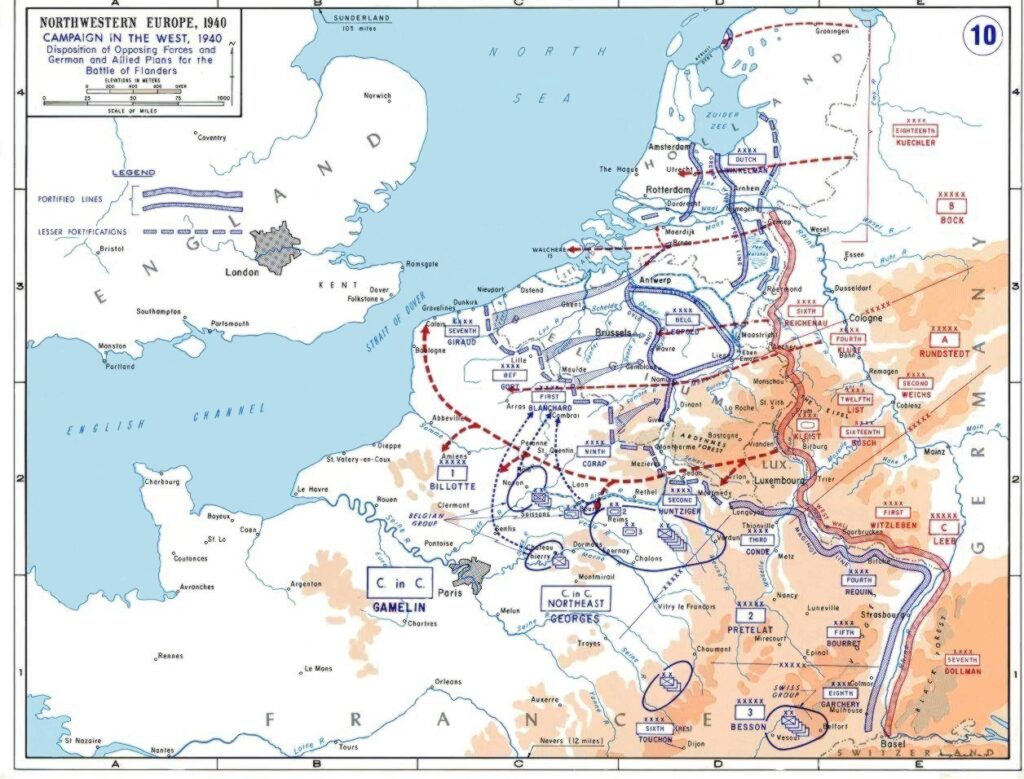
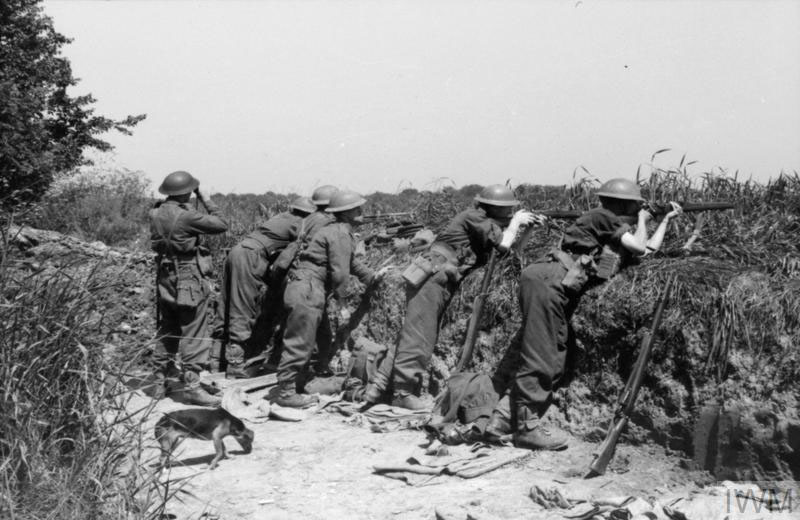
In 1940 the regular 51st (Highland Division), with cross-posted Territorial Units from the 9th Division, and reinforced with units from the Royal Artillery, Cavalry, Machine Gun Units, Infantry Sappers and Royal Engineers was deployed as part of the British Expeditionary Force (BEF) in France as the Saar Force on the Saar River, under French command.
Initial deployment 1940
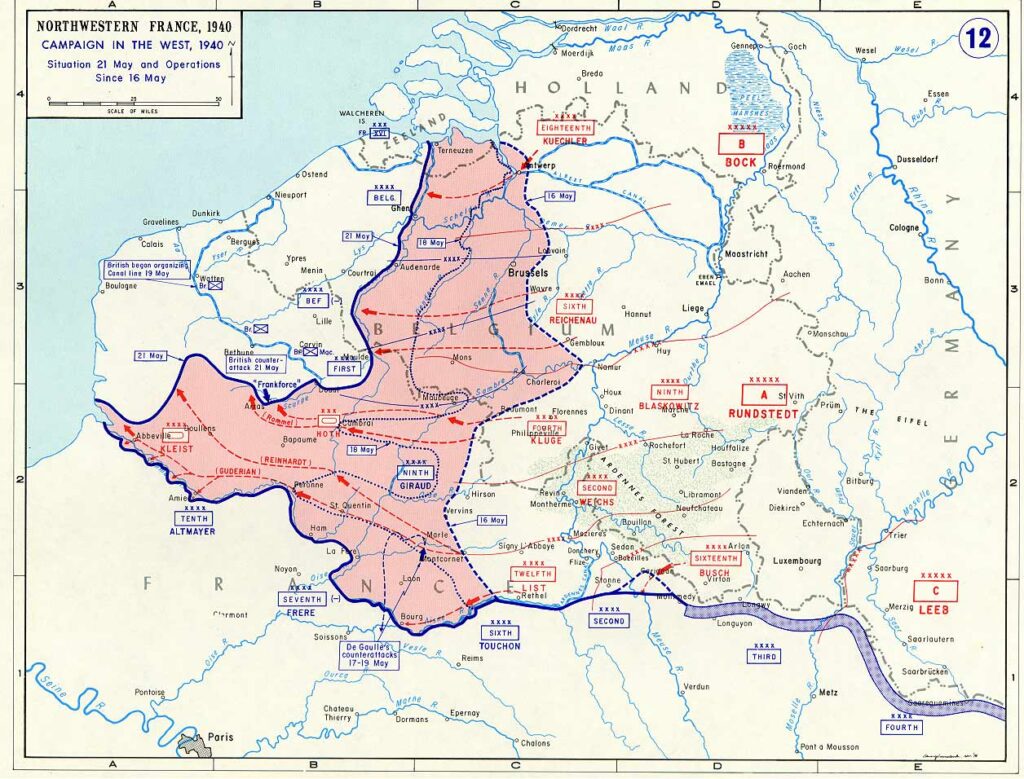
After the German Blitzkrieg on 10th May drove a wedge between the BEF and the French Army, they withdrew to Abbeville, as part of the French 9th Army. The intention was to evacuate the Division from Le Havre, and the 154th Brigade (re-named Ark Force) consisting of the 1st Black Watch and 7th and 8th Argylls, were sent there, but came under pressure from the encircling Germany forces and after putting up fierce resistance with some captured, eventually evacuated safely from Le Havre* and Cherbourg. The remainder of the Division concentrated at St Valéry. And so The 51st Division fought on in France after the main part of the BEF had been evacuated on 4th June. A fierce battle developed and The 2nd and 4th Seaforth Highlanders, 4th Cameron Highlanders, 1st and 5th Gordon Highlanders and the 4th Black Watch fought determinedly at St Valéry-en-Caux until completely surrounded, out of ammunition and supplies, and were overwhelmed by Rommel and ordered to surrender on 12th June 1940. Some 10,000 were taken prisoner. These Regiments have St Valéry-en-Caux as a Battle Honour.
Positions 16th-21st May 1940
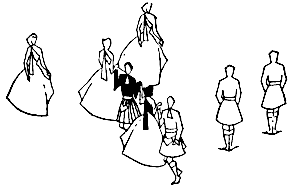
The 51st Highland Division in 1940 is perhaps best recalled in the Scottish Country Dance “The Reel of the 51st” in which the dancers recreate the Scotland’s Flag and the Battle Dress Badge of the Division in 1939/1940. The dance was created by the officers of 51st Highland in their prison camp at Laufen during the long dark days of captivity following 1940. During the reel the couples balance in line twice forming the branches of the Saltire, their Badge. When dancers today break the balance in-line turn their partners twice they are actually breaking the Saltire.
Balancing in line to the corners creates the Saltire
My interest in 51st Highland in 1940 began with my Mother telling me about the men from her village of Cluny, Aberdeenshire, Territorials in the Gordon Highlanders, who went to their TA Camp in 1939, were deployed to France in 1939 as part of the BEF and were left behind in France in 1940 when the rest of the BEF were evacuated from Dunkirk, went into captivity at St Valery-en-Caux and would not return until the War ended. They included Donald Macleod, Sandy Ross and Peter Ferries.