
The Battle of Culloden
16th April 1746
The Battle of Culloden, on the 16th April 1746 was not a Scots defeat at the hands of the English as often portrayed, nor was this Highland v Lowland or Catholic v Protestant. The defeated Jacobite Army had French Regular Troops in its ranks. The Government Army included famous Scottish Regiments: The Royal Scots (2/1st Royal Regiment, St Clair’s) (2nd Battalion); The Royal Scots Fusiliers (21st North British Fusiliers), the Kings Own Scottish Borderers (Sempill’s) and the precursors of The Argyll and Sutherland Highlanders, The Argyll Militia. No Regiment has Culloden as a Battle Honour.
The Battle and its aftermath saw the dismantling of the culture of the Highland Gael, the Clan system, and the Highland Dress Act, part of the Proscription Act. But one of the witnesses at the Battle, James Wolfe, would deploy the descendants of these Highlanders in the British Army, and the British Army became the custodian of the Great Highland Bagpipe, kilts and tartans, and some of the Highland traditions.
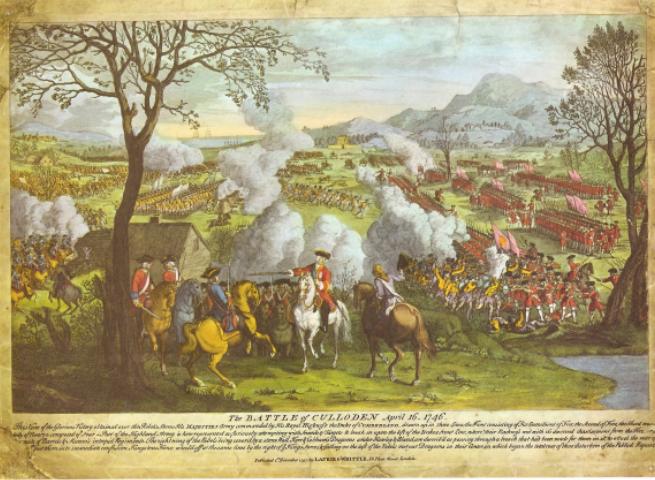
A map of the Battle dated 23rd April 1746 by Thomas Sandby (1721-1798).

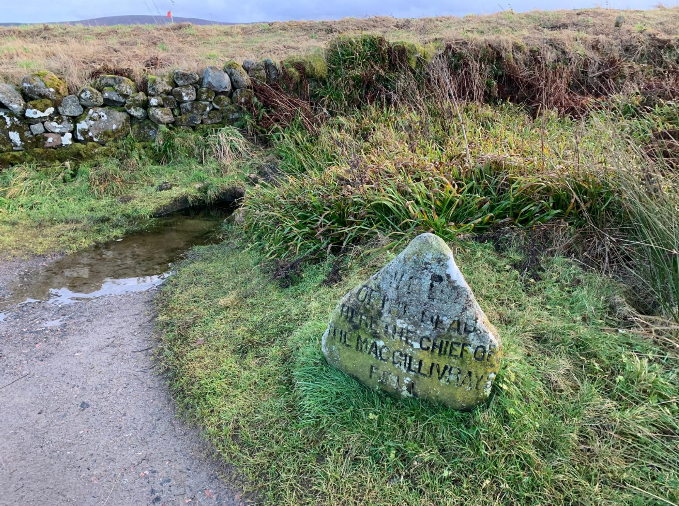
Lady Mackintosh’s Regiment (Clan Chattan Confederation) was led by Colonel Alexander McGillivray. “Colonel Anne” (née Farquharson) raised the Clan for the Jacobite Cause as the Clan Chief, Aeneas Mackintosh was serving in the Black Watch in the Government Army.
The Royal Ecossais (Royal Scots) were one of two French Regular Army Regiments to fight at Culloden. The other was the Irish Piquets. Both were formed by exiles from Scotland and from Ireland. Unlike the Highlanders they were taken prisoner and subsequently exchanged save for a small number identified as deserters who were executed following courts martial.
The Royal Ecossais and Irish Piquets, in the second line, fought a succesful rearguard action before surrendering.
Eye Witness Accounts
Colonel Christopher Teesdale, 3rd Buffs, to John Home
London, 15 January 1792.
I quitted the army in the year 1762 and have (from the length of time) almost forgot that I was ever a military man. Now you unconscionable fellow, you desire me to remember occurrences 46 years ago. However, I will do my best with regard to the battle of Culloden, which I believe is what you want to know. The day before the action the Royal army encamped within about ten miles of the rebels – it was, I remember, the Duke of Cumberland’s birthday. The rebels imagining the troops might be induced to make merry on the occasion came to a resolution to attack the Royal army in the dark, and certainly a very wise scheme (and no doubt some of them might have read the description of the attack made by Leonidas on the Persian camp in the night,) for certainly an army composed of even the best militia do not judge well to oppose themselves to a well provided army, as the consequence plainly demonstrated. In the dark things are but on an equal footing; artillery cannot be used, nor small arms without the risk of killing as many of your friends as foes; but you know as well as I do why they did not attack in the dark. I should think it must have been owing to either the treachery of Lord John Murray or perhaps his fear of not being well supported. When daylight began to appear we had information of the enemy’s intention, and they had just begun their retreat. The Duke of Cumberland then formed the army, and marched towards the rebels, who only had time to form on a rising ground on Drummosse or Culloden Moor. The Royal army marched in three columns and formed battle (in view of the enemy) in two lines and a corps d’reserve, with the dragoons on the flanks, and these moved forward with ten field pieces (short Saxon six-pounders) in the front, and when we came within reach of cannon shot our field pieces were got into a bog, so that the horses were obliged to be taken off, and the soldiers to sling their arms in order to drag the guns across the bog, which required
some time. If the enemy thought our artillery could not be drawn across the bogs their ground was certainly well chosen, and had they immediately come down with rapidity the battle would have been fought without cannon, but they amused themselves with pointing a few guns so ill served as actually to make our soldiers laugh, for I well remember their first shot went some distance beyond our corps d’reserve. As soon as our cannon was clear of the bog, Colonel Bedford (a most excellent artillery officer) began to cannonade with such success that they were unable to stand it, and came down in a rapid and determined manner. When Bedford perceived them at proper distance he then poured in grape shot that mowed them down in such a manner that their columns only extended to oppose the 4th and 20th Regiments, in which regiments they made some havoc. Lieut.-Colonel Martin (a Sussex man) on the left of the front line, seeing no part of the rebels opposite the 8th Regiment he commanded, wheeled the regiment, and took them in flank, which made terrible havoc, and when they retreated Kingston’s Light Horse did great execution. Their loss was computed at near three thousand. I saw the field of battle next day, and think that there could not be many less,including those killed in the pursuit.
Now with regard to the question, you ask me, I well remember that, when our army formed in line of battle, the left of the enemy’s front line seemed to extend much beyond right of our front line, and the Duke of Cumberland ordered two regiments from the corps d’reserve (their numbers or names I have forgot) to move up, one on the right of the Royal Scotch and one on the right of the Buffs, or 3rd Regiment. I do not suppose 80 men were lost by the Royal Army. Poor Lord Robert Kerr, uncle of the present Marquis of Lothian, the handsomest and one of the worthiest men in the world, was slain. He was a captain in the 4th Regiment, and the Duke of Cumberland had his major’s commission in his pocket, and said “we will let Kerr know nothing of the matter till the battle’s over.” And now I have acquainted you with all the particulars which occur to me at present. Had the rebels marched into the Highlands and not fought the battle, one-half of the Royal army must have been destroyed before they could have been subdued.
P.S. – A letter to me comes free directed Office of Ordnance. Pray tell me how this corresponds with any other information you are possessed of. The British Cavalry consisted of two heavy regiments and the Duke of Kingston’s Light Horse. The enemy had some French cavalry and pickets of the Irish Brigade. The pretender did not come down with his troops, which was shabby.
The “Royal Scotch” referred to are St Clair’s Regiment, The Royal Scots (The Royal Regiment)
James St Clair was their Colonel, an honorary title which he held from 1737-1762, and was not in command there as erroneously recorded on a number of websites. In the custom of the time the Regiment was known by its Colonel’s name. St Clair was by the time of Culloden a Lieutenant General, having been appointed Quartermaster General to the British Army in Flanders in 1745 and Commander-in-Chief of an expedition which destroyed the forts at Quiberon in 1746. He was an Ensign with the 1st Royals in 1694 but transferred to 3rd Footguards as a Captain in 1714.
The Regiment brought up from the reserves to the right of The Royal Scots was Pulteney’s. Their Colonel was from the Bath Family, Pulteney. Frances Pultney married Edinburgh Lawyer William Johnstone who added her surname to his and with Thomas Telford built the new Harbour and New Town in Wick, named Pultney Town which had a distillery. This is how Old Pultney got its name.
Inverness, 17 April 1746
The Duke engaged with the rebel army, and in about an hour drove them from the field of battle, where they left near 1500 dead; the rest, except prisoners, escaped by the neighbourhood of the hills.
The rebels posted themselves on a high boggy moor, where they imagined our cannon and cavalry would be useless; but both did essential service. The cannon in particular made them very uneasy, and after firing a quarter of an hour, obliged them to change their situation and move forward some 100 yards to attack our front line of Foot, which they did with more fury than prudence, throwing down their firearms, and advancing with their drawn swords. They were however repulsed, and ran off with the greatest precipitation, and the Dragoons falling in amongst them completed the victory with much slaughter. We have taken about 20 pieces of cannon in the field and 700 prisoners, amongst which are all the Irish piquets, and broadswords, plaids innumberable.
Orders were publicly given in the rebel army, the day before the action, that no quarter should be given to our troops. We had an opportunity of avenging ourselves, and I assure you as few prisoners were taken of the Highlanders as possible…. May they ever be punished in the same manner who attempt the like!
Cumberland’s “no quarter” order was based on the allegation that the Jacobite Army had previously issued such an order. This was untrue. The only evidence produced was a single unsigned forgery.
After the Battle it is said that Cumberland (though more likely Hawley to whom he was ADC) ordered James Wolfe “Wolfe, shoot me that rebel dog,” Wolfe declined, “My commission is at Your Highness’s disposal, but I can never consent to become an executioner.” The rebel was Charles Fraser of Inverallochy. Charles Fraser commanded Lovat’s Regiment at Culloden, Simon Fraser, The Master of Lovat, with a smaller force of Frasers, was between Inverness and Culloden. His father, Lord Lovat, “The Old Fox”, then 79, was executed for his role in the rising.
In 1759 Wolfe captured Quebec with the 78th Fraser Highlanders, raised by Simon Fraser, now Clan Chief, played a crucial role at the Plains of Abraham carrying out a Highland Charge. The painting “The Death of Wolfe” symbolically includes Simon Fraser, Lt Col of The Fraser Highlanders.
Our Noble ancestors are thought to have fought at Culloden.
The Battlefield continues to give up evidence of the action. An unexploded Coehorn Mortar shell found in October 2025.