
The Battle of Flodden
9th September 1513
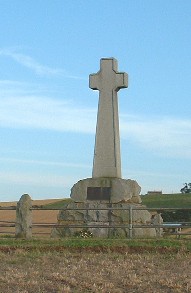
The battle of Flodden Field, near Branxton Northumberland. The Scottish Army was led by James IV and English Army was led by Thomas Howard Earl of Surrey were roughly similar in size, numbering between 20 and 30,000 men. The Scottish Camp on Flodden Hill was a favourable position which they had fortified. Surrey understanding this marched to outflank the Scots, positioning himself between them and Scotland. On the day of the battle James moved his army to Branxton Hill. Both forces had sophisticated artillery, but the lighter and more manoeuvrable pieces used by the English were more suited to the rain-soaked conditions of the hill and soon took effect. In the initial action Hume and Huntly on the Scots’ right appeared to break the English left flank. The Scottish centre seeing the success advanced but they lost momentum on the boggy ground and their traditional long spears were overcome by the English billhooks James joined the attack and ran into similar difficulties and the Scots formations broke down into hand to hand combat in the dip between the hill and Branxton with the Scots coming under effective fire from the English archers.
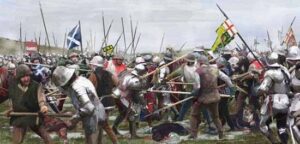
The field was so soaked with blood that many of the Scots removed their shoes to gain a better purchase on the slippery ground. The Scots casualties were heavy, said to be close to 10,000 killed, including the King, nine earls, fourteen lords and a handful of prominent clerics, including the Archbishop of St.Andrews. English casualties amounted to some 4,000.
The Scots dead were so mutilated that many of the bodies could not be identified, though the body believed to be that of James IV, pierced with arrows, his left hand almost severed from his arm by several wounds and his neck opened to the middle, was taken to Berwick and embalmed, “lapped” in a lead sheet and then to the Priory of Sheen , where it was kept finally in a lumber room Elizabeth I’s Master Glazier, Lancelot Young, found the head hewn off by “idle workmen for their foolish pleasure” and noticing it smelling sweetly, perhaps from the spices used it for embalming took it home but eventually charged the Sexton to have it taken to the charnel house St Michael’s Church, Wood Street in the City of London for disposal. The Church was destroyed in the Great Fire of London. and rebuilt by Wren. There is no record of the body after the 16th century and Sheen Priory buildings became dilapidated and were demolished. The foundations lie under the 14th fairway of the the Outer Course Old Deer Park.
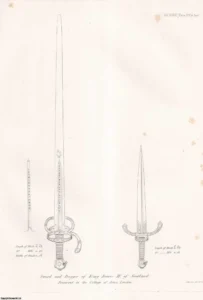
A sword, dagger and ring said to have been taken from the body of James IV and kept at the College of Arms in London are probably not his.
Many Scottish Nobles and Lairds including William, the 2nd Earl of Caithness along with George Sinclair of Keiss, Henry, 3rd Lord Sinclair, Sir John Sinclair of Herdmanston and the Bishop of Caithness fell at Flodden. The Earl of Caithness had raised a body of around 300 Caithness men. It was a catastrophe for the whole of Scotland.
At the time the Earl of Caithness was under an attainder and so, it was said that when King James saw them in his ranks, he sent for the Earl and pardoned him. It is said thast the Earl asked for written confirmation , and so, with no parchment to hand, hastily wrote the pardon on a Sinclair drumhead He sent it home with a member of Clan Gunn who was the only survivor of the Caithness force. The charter has been with the Earl of Fife since 1766.
The day is also associated with Sinclair/Caithness folklore as the Sinclairs crossed the Ord of Caithness on a Monday wearing the Green tartan, and to this day it is deemed unlucky to cross the Ord on a Monday wearing Green.
The tragedy is remembered in the pipe lament “Flowers of the Forest” and the folk song of the same name:
I’ve heard the lilting, at the yowe-milking,
Lasses a-lilting before dawn o’ day;
But now they are moaning on ilka green loaning;
“The Flowers of the Forest are a’ wede away”.
As buchts, in the morning, nae blythe lads are scorning;
The lasses are lonely and dowie and wae.
Nae daffin’, nae gabbin’, but sighing and sobbing,
Ilk ane lifts her leglen, and hies her away.
In hairst, at the shearing, nae youths now are jeering,
The Bandsters are lyart, and runkled and grey.
At fair or at preaching, nae wooing, nae fleeching,
The Flowers of the Forest are a’ wede away.
At e’en, in the gloaming, nae swankies are roaming,
‘Bout stacks wi’ the lasses at bogle to play.
But ilk ane sits drearie, lamenting her dearie,
The Flowers of the Forest are a’ wede away.
Dule and wae for the order sent our lads to the Border;
The English, for ance, by guile wan the day:
The Flowers of the Forest, that foucht aye the foremost,
The prime o’ our land are cauld in the clay.
We’ll hae nae mair lilting, at the yowe-milking,
Women and bairns are dowie and wae.
Sighing and moaning, on ilka green loaning,
The Flowers of the forest are all wede away.
Meaning of unusual words:
yowe=ewe
ilka=every
wede=withered
buchts=cattle pens
dowie-sad
wae=woeful
daffin’=dallying
gabbin’=talking
leglen=stool
hairst=harvest
bandsters=binders
lyart=grizzled
runkled=crumpled
fleeching=coaxing
gloaming=twilight
swankies=young lads
bogle=peek-a-boo
dule=mourning clothes
