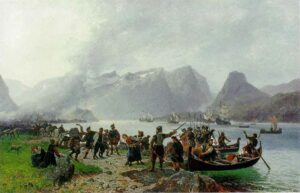
In 1612 a force it is now thought of some 300* Scots (the initial Norwegian Report said 550 Scots were defeated by 450 Militia, but by the 1789 Norwegian accounts had inflated the Scots number to 900) arrived in Gudbrandsdalen under the command of acting Lieutenant Colonel (substantive Captain, later Major) Alexander Ramsay ¹ with a company of 100 from the south of Scotland, a company of 100 Caithness men led by Captain George Sinclair ² of Stirkoke (for many years George Sinclair was thought to be the leader and Ramsay was forgotten) and another company of 100 men led by Captain George Hay ³. George Sinclair was a captain in Samuel Cockburn’s regiment in Sweden 1610-12, and had recruited for James Spens for the Swedish Army 1611-12. He was allegedly accused of forcibly taking children and servants onto the transport ships. Alexander Ramsay recruited with Robert Kerr and Captain George Hay ³ (also of Samuel Cockburn’s regiment), and had sailed from Dundee with his company. They were simply passing through the valley intent on reaching Sweden, which was then at war with Norway and Denmark over the territory of Kalmar in the south of Scandinavia. Their passage through Norway had been peaceful ¤ since their landing at the Isfjorden on the coast of Romsdal and Møre, and they could not have anticipated what awaited them at Kringen.
They did not know that young men conscripted from the valley had been massacred in the Kalmar conflict, and that the farmers from Gudbrandsdalen were determined to resist them. Plans had been laid for an ambush, and the ambush was to be triggered by local girl, Guri, who was to watch the column as it made its slow passage along the old King’s road.
To further distract the Scots from the ambush preparations, tradition adds that a man rode sitting backwards on his horse. Once the right moment arrived, Guri, watching from the mountain top above Otta blew a blast on her lur, a long wooden horn, or perhaps a buckhorn, traditional to the area. Local tales have it that the ambush started with logs and rocks crashing down on the Scots from the steep mountainside and blocking the road preventing advance or withdrawal, and Norwegian folklore records that George Sinclair was felled with a silver bullet from a single musket shot fired by Berdon Sejelstad. 450 farmers fell on the Scots with their axes and scythes and fierce hand-to-hand conflict ensued that left the river running red with blood.
After one and a half hours, only 134 Scots remained alive though it is thought some escaped. The farmers lost 6 men. It is thought that the Scots had only a few weapons between them, expecting to be armed when they reached Sweden.
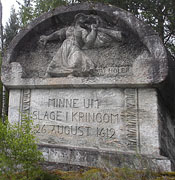
The 1912 Memorial with the carving of Pillarguri at the Battle Site. Photo courtesy of Per-2-Peer.
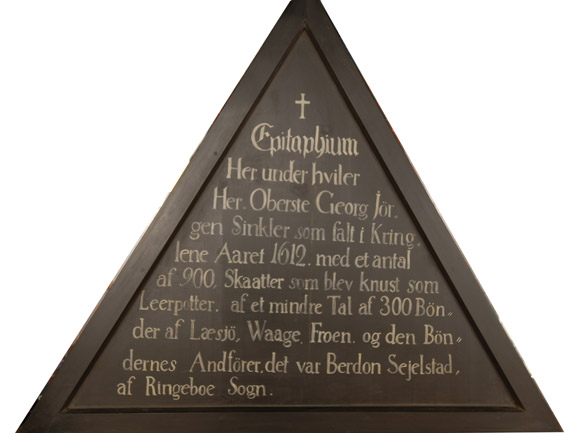
The 1789 †Marker of Oberst “Colonel” Sinclair’s Grave and Battle details:
“Epitaph Here under rests Colonel Georg Sinkler Fallen at Kringlen in the Year 1612 with the number of 900 Scots who were crushed like clay pots by the smaller number of 300 farmers from Læsjö, Waage, Froen. The farmers’ leader was Berdon Sejelstad from Ringeboe, Sogn”
”Slaget ved Kringen (1612).” – tekst på illustrasjon av A.Bloch (1860-1917). Illustrasjonen er nr. 57 i ein biletserie i faget historie til bruk i folkeskulen (grunnskulen).
Photo courtesy of Jon Selfors, Verthuset Sinclair, Kvam
The survivors were taken prisoner and led off to Kvam, and were to be taken to the Akershus Fortress in Oslo to await their fate, but the farmers had their harvest to think of, and again, tradition has it, they began to execute the prisoners. Certainly only 18, were taken to Oslo and forced into Danish-Norwegian service. Four of the officers, Alexander Ramsay , James Scott, unofficially recruited in Scotland 4, Captain Henry Bruce 5 and Lieutenant James Monneypenny 6, a translator, previously in Danish-Norwegian service, were sent to Copenhagen where they were taken in by the British Ambassador to the court of Christian IV, Sir Robert Anstruther 7, who returned them home after a summary interrogation. Captain Hay is not listed among the surviving officers and is thought to have been killed at Kringen. Ensign John Bowie 8 was released on 31st December 1612. There were certainly many survivors, and there is tradition of the local “Skotte” (Scots) farms being cleared by one such survivor. We have recently learned of a survivor who escaped from the Akershus Fortress and made his way to Sweden, where his descendants still live. In Gudbrandsdalen today, the local costume “bunad” incorporates a Tartan that is reminiscent of the Red Sinclair.
Local Bunad Waistcoat
Syver Bakken’s book “Ringen om Kringen”, published 1999, in Norwegian, is the best recent authority on the Battle and its origins and aftermath. It is only now available in local libraries.
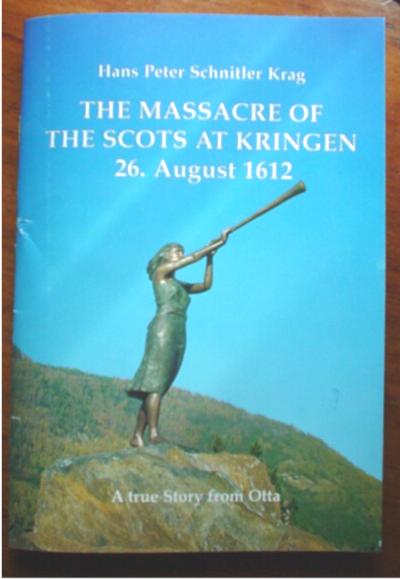
In May 2001 Per A Holst re-published “The Massacre of the Scots at Kringen, 26th August 1612, based on accounts gathered in the Gudbrandsdalen Valley by Hans Petter Schnitler Krag, Pastor of the Parish of Vågå, 1820-1845” first published in 1838. This is a rather uncomfortable read based on the oral tradition that had built up in the valley and is an alternative version of events with some interesting illustrations. It is available from Otta Libris, Johan Nygaardsgt. 17 B, , Tel: +47 61 23 00 14
References: “Ringen om Kringen” by Syver Bakken, 1999 The Massacre of the Scots at Kringen, 26th August 1612, based on accounts gathered in the Gudbrandsdalen Valley by Hans Petter Schnitler Krag, Pastor of the Parish of Vågå, 1820-1845, Per Holst 2001 Herr Sinclair dro over salten hav : skottetoget og kampene ved Kringen 1612 (George Sinclair who crossed the Salty Sea: Scottish March and Battle at Kringen 1612) by Rolf Rach-Engh University of St Andrews Institute of Historical Research The Scotland, Scandinavia and Northern European Biographical Database (SSNE) (Requires Registration, log in and then the links below will open)
¹ Record ID: 230 Alexander Ramsay
² Record ID: 4233 Captain George Sinclair ³ Record ID: 4236 Captain George Hay 4 Record ID: 7274 James Scott 5 Record ID: 241 Captain (or Lieutenant) Henry Bruce 6 Record ID: 245 Lieutenant James Monneypenney 7 Record ID: 1472 Sir Robert Anstruther
8 Record ID: 242 Ensign John Bowie * p 43 History of the Scottish Expedition to Norway in 1612 by Thomas Michell, 1886 (Ambassador to Denmark-Norway, Sir Robert Anstruther reported 300) (see below) ¤ p 185 of same Historical Document, 2nd Official Report to the Danish Chancellor: “We have also since ascertained that those Scots who were defeated and captured on their march through this country have absolutely neither burned, murdered, nor destroyed on their march through this country, either in Romsdalen or Gudbrandsdalen” Only the theft of a box of valuables from one man was reported. † p121 of same. p 201 – 203 History of the Norwegian People by Knut Gjerset, Vol II, 1915 (see below)
Swords for Hire by James Miller ISBN 9781841584461 published 2007 by Birlinn Limited Scottish Military Disasters by Paul Cowan includes Massacre in Norway, Kringen 1612 ISBN 978-1-903238-96-7 published 2008 by Neil Wilson Publishing
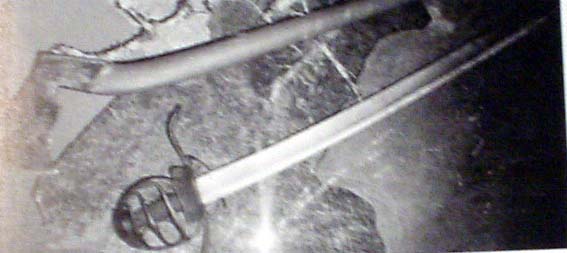
Weapons in the Gudbrandsalen War Museum at Kvam
Lorem ipsum dolor sit amet, consectetur adipiscing elit. Ut elit tellus, luctus nec ullamcorper mattis, pulvinar dapibus leo.