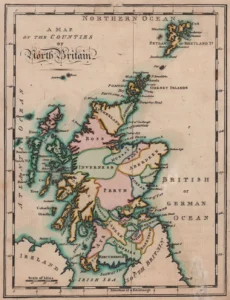
“Fareweel even to the Scottish name” in Such a Parcel of Rogues refers to the alternative naming of Scotland after the Act of Union of 1707 as “North Britain”.
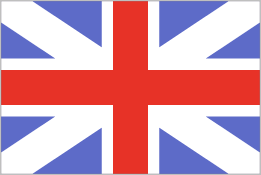
Some Scots chose to fly a combined flag where the Cross of St Andrew overlaid the Cross of St George. No original flags survive, this illustration is from 1704.
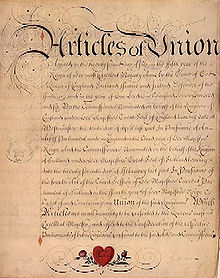
"Articles of Union otherwise known as Treaty of Union", 1707
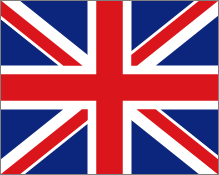
Ireland continued as a separated kingdom under the same monarch as the Kingdom of Great Britain until 1801 when a new Act of Union created the new United Kingdomof Great Britain and Ireland. The Union Flag was amended with the Red Saltire of St Patrick counter changed with the White Cross of St Andrew. In 1921 southern Ireland achieved independence as the Irish Free State and is now the Republic of Ireland, while northern Ireland remained in what then became the United Kingdom of Great Britain and Northern Ireland.
The Union Flag of 1801
North Britain and North Britain British continued as terms for Scotland and Scottish in the 19th Century. In 1815 the Regiment better known as the Royal Scots Greys (until merged with the 3rd Carabiniers (Prince of Wales Dragoon Guards) as the Royal Scots Dragoon Guards) were named as the Royal North British Dragoons. The Regiment better known as The Royal Scots Fusiliers were named the 21st Regiment of Foot (Royal North British Fusiliers) from 1713 to 1877. In the Nineteenth Century the Postal Address for Scotland was “N.B.” for “North Britain” as that was the official GPO designation (General Post Office, Post Office from 1969, it did not become Royal Mail until 1986). (Linked example 1890 postcard redirected to “Atholl Hydropathic, Pitlochry, N.B.”). An 1894 Guidebook by M J B Baddely recorded, p 178, “The names enclosed in square brackets are required to complete the postal address, to which “N.B.” (“North Britain”) should always be added in England”,
The Colours of The 21st Regiment of Foot (Royal North British Fusiliers) in 1849
From the early 20th Century Scotland and Scottish became the dominant terms once again.
“South Britain” and “South British” never gained the same usage in England and Wales, and Scotland has survived as an outward looking, welcoming European Nation which shook off three centuries of promotion of the alternative.
A map of the lines of the North British Railway from The Railway Year Book for 1920.